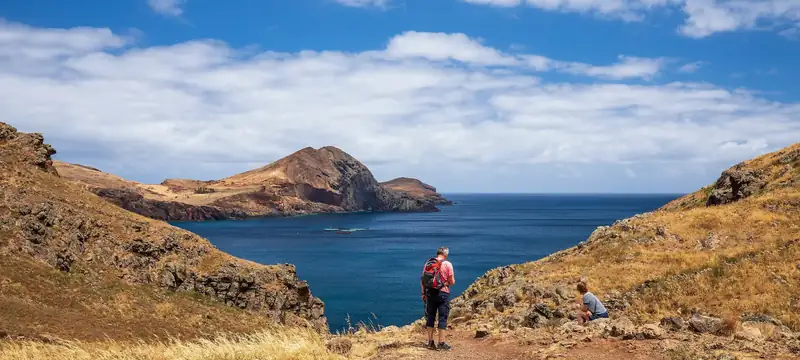
Coasteering means moving along the coastline itself: swimming between rock platforms, scrambling over them, snorkelling through sea caves and jumping in from whatever height you choose. It is guided, the gear is provided and you need no experience beyond being able to swim. Most Madeira trips run about 4 hours from ~€70 with hotel pickup, on the sheltered south-east coast around Caniçal and Ponta de São Lourenço, and every jump is optional.
What is coasteering?
A guide picks a section of cliff and you traverse it at sea level. In practice that means alternating between swimming across small bays, climbing out onto rock shelves, working along ledges, ducking into sea caves and dropping back into the water off whichever rock you choose.
You are put in a wetsuit, helmet and buoyancy aid before you start, so you float whether you want to or not, and the neoprene takes the sting out of both the cold and the barnacles. Some trips add snorkel gear.
The guide sets the line and reads the swell. That is the whole skill of it: which platform is safe to stand on with this size of wave running, and which entry to use. You follow.
Coasteering or canyoning in Madeira?
They are the two guided adventure days on the island, they cost roughly the same, and people ask which one to pick.
| Coasteering | Canyoning | |
|---|---|---|
| Where | Along the coast, at sea level | Down a forest ravine |
| Water | Salt, Atlantic | Fresh, spring-fed |
| Core move | Swimming, scrambling, cliff jumps | Rappelling on a rope |
| Cancelled by | Swell and sea state | Heavy rain and flow |
| Best months | June to November | Year-round |
| Skill needed | Swimming | Swimming, plus a head for heights |
If you want the rope work and the waterfalls, do canyoning. If you would rather be in open water and jumping off things, do this. In a longer trip they pair well, because the weather that ruins one often suits the other.
Where you go
The usual site is the Baía d'Abra area near Caniçal, inside the protected reserve at the island's eastern tip. It is the clearest water on Madeira and the most sheltered coastline, which is why almost every operator ends up there rather than on the exposed north coast.
The coast around Ponta de São Lourenço is the same geology you see from the walking trail above: bare ochre rock, sea caves and deep blue water. Some trips reach their start point by boat, which opens up sections you cannot walk into and usually adds an hour to the day.
Caniçal is roughly 30 minutes east of Funchal, and pickup is normally included, so you do not need a car for this.
How high are the jumps?
Between about 1 and 15 metres, and you choose. That range is the honest answer to the question people actually mean, which is whether they will be pressured into something.
They will not. At every jump point there is a lower ledge, and usually a climb-down that skips it entirely. Plenty of people do the whole route without leaving the water voluntarily, and plenty do every jump twice. Guides will talk you into a 3 m drop if you want talking into it, and will not push past that.
The one thing that is not optional is the swimming. There is no walk-around for the crossings between platforms.
What is included and what to bring
Included: wetsuit, helmet, buoyancy aid, the guide, and usually hotel pickup from the Funchal area. Snorkel gear on the trips that feature it.
- Wear: swimwear under your clothes, since changing happens at the coast rather than in a facility.
- Shoes: old trainers or proper water shoes you can swim in. Not flip-flops, and not bare feet on barnacled rock.
- Bring: a towel, a full change of dry clothes, sun cream and sunglasses on a strap.
- Leave behind: phones and anything not waterproof. Guides usually take photos.
Is it safe, and who is it for?
Commercial operators in Portugal must hold an RNAAT registration and carry the personal-accident insurance the law requires for adventure tourism, so the guide leading you is licensed and insured. Group sizes are small and every obstacle has an easier alternative, which is why it works for families and for nervous first-timers in a way that harder adventure sports do not.
The real limiter is the sea. Operators move or cancel trips when the swell is up, because a rock platform that is fine in flat water is not fine with a metre of surge on it. Take the cancellation as a sign of a decent operator rather than a wasted day.
When to go
Sea temperature runs from around 18°C in late winter to roughly 23 to 24°C in late summer, and the practical coasteering window is about June to November. September is the sweet spot: the water is at its warmest, the summer crowds have thinned and the Atlantic is usually still calm.
Winter trips do run in a thicker wetsuit, but the swell closes more of the route more often, so you get a shorter day and a higher chance of a reschedule. Outside those months, the scuba diving operators face the same constraint for the same reason.
It slots neatly into a week alongside the calmer entries in our things to do in Madeira guide, and it is the better half-day if you have already given a full day to the west coast.
For a longer version, the five-hour coasteering trip with snorkelling reaches its site by boat and works out at around €65 to €70.
Do you need experience to go coasteering in Madeira?
No. Coasteering trips in Madeira are guided and beginner-friendly, and the only real requirement is that you can swim confidently in open water. Wetsuit, helmet and buoyancy aid are provided, and every jump and scramble has an easier alternative.
How much does coasteering in Madeira cost?
From around €70 per person for a four-hour trip in 2026, including the wetsuit, helmet, buoyancy aid, a guide and hotel pickup from the Funchal area. Longer five-hour trips that reach the site by boat and include snorkelling cost around €65 to €70.
Do you have to do the cliff jumps?
No. Jumps range from about 1 to 15 metres and every one is optional, with a lower ledge or a climb-down at each point. You can complete the whole route without jumping from height. The swimming between rock platforms is the part that is not optional.
Is coasteering safe in Madeira?
With a licensed operator, yes. Portuguese law requires adventure-tourism companies to hold RNAAT registration and carry personal-accident insurance, groups are small and guides read the swell. Trips are moved or cancelled when the sea is rough, which is the main safety control.
Should I do coasteering or canyoning in Madeira?
Coasteering if you want salt water, open sea and cliff jumps, and canyoning if you want waterfalls, rope rappels and forest. Both are guided, both cost around €70 and both suit beginners. Coasteering depends on the sea state and canyoning on rainfall, so they cancel on different days.
What is the minimum age for coasteering in Madeira?
Operators generally take anyone who can swim confidently, including children, rather than setting a hard age limit, but policies differ. Check the specific listing before booking for a child, and tell the operator in advance so the guide can pick a gentler line.
Photo: Ximonic (Simo Räsänen) / Wikimedia Commons / CC BY-SA 4.0


