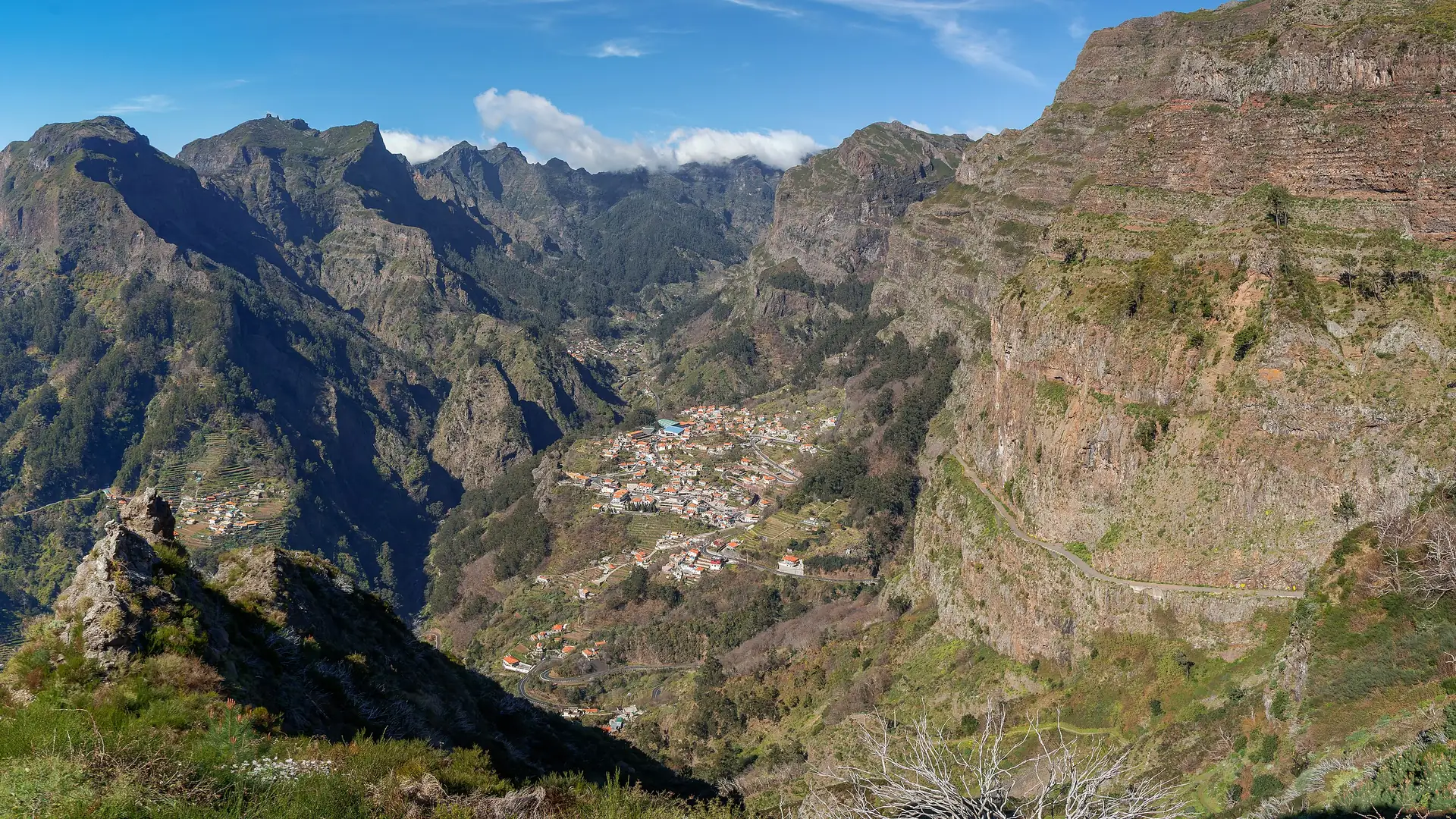
Curral das Freiras sits on the floor of what looks like a crater, a village of a few hundred people ringed by mountain walls that go almost straight up. The classic version of the visit is the Eira do Serrado viewpoint at around 1,095 m, looking down on the rooftops, then the village itself for chestnut cake and chestnut liqueur.
It is a half-day, not a full day. Reckon on about 30 minutes from Funchal by car through the tunnel, 45 to 60 minutes on bus 81, or 3.5 hours door to door on a guided tour from ~€33.
Madeira: Nuns Valley Half-Day Tour
The half-day version: driven from Funchal to the Eira do Serrado viewpoint high above the crater, down into Curral das Freiras itself, and back via the fishing village of Câmara de Lobos for a glass of poncha.
- Eira do Serrado clifftop viewpoint and the village
- Câmara de Lobos and a poncha stop on the way back
- 3.5 hours, hotel pickup in Funchal
- Free cancellation up to 24 hours before
Total price from
~€33
Includes taxes and fees
Powered by Lido Tours
How to get to Curral das Freiras from Funchal
Three options, and they suit different trips.
- By car: roughly 30 minutes via the tunnel on the ER107, with parking in the village and a separate car park at Eira do Serrado. The old road over the mountain is slower, narrower and far more scenic.
- By bus: Rodoeste route 81 runs from Funchal to Curral das Freiras in about 45 to 60 minutes, roughly hourly, and it is one of the few genuinely worthwhile Madeira day trips you can do on public transport.
- By tour: a half-day minibus tour with hotel pickup covers the viewpoint, the village and Câmara de Lobos in 3.5 hours.
The catch with the bus is that it goes to the village, not to Eira do Serrado, and the viewpoint is the better half of the day. If you are relying on buses, either accept the village on its own or plan to walk down from the viewpoint. Our guide to Madeira without a car covers how the network behaves elsewhere.
The Eira do Serrado viewpoint
Eira do Serrado is the reason this trip exists. A short paved path from the car park, five minutes at most, brings you out on a platform at around 1,095 m with the whole valley below: the village on the flat floor, terraced plots up the lower slopes, and mountain walls closing it in on every side.
It is the classic Madeira photograph and it takes less time than getting there. There is a small hotel and a kiosk at the car park selling drinks, chestnut products and the usual souvenirs.
Cloud is the variable. The valley traps it, and by mid-afternoon the view is often a wall of white. Mornings are markedly more reliable.
Can you walk down to the village?
Yes, and it is the best thing to do here if your knees are up to it. An old stone footpath drops from Eira do Serrado to Curral das Freiras in about an hour, switchbacking down through eucalyptus and terraces, and it is how people made this journey before the road.
Two things to plan. It is steep and loose in places, so proper shoes matter and walking poles help. And it is one way: you will not want to climb back up, so arrange to be collected in the village, take bus 81 back to Funchal, or have a driver meet you.
If you are already up for something more strenuous nearby, the beginner canyoning trips pick up at Curral das Freiras and run in the ravines above the valley.
The village
Curral das Freiras is a working village rather than a sight, and that is part of the appeal. There is a church, a handful of cafés and restaurants along the main street, and steep terraces of chestnut and fruit trees behind. Half an hour to an hour covers it.
The local economy runs on chestnuts, and everything is made from them. Look for bolo de castanha, a dense chestnut cake, licor de castanha, a sweet chestnut liqueur usually offered as a free taster, and chestnut soup in the restaurants. Cherries in season are the other speciality.
Why is it called the Valley of the Nuns?
The name comes from the Santa Clara convent in Funchal, which owned land here. When French pirates sacked Funchal in 1566, the nuns fled inland and sheltered in this valley, which was effectively unreachable at the time.
That inaccessibility is the whole story of the place. Until the modern road and tunnel, the only ways in were the footpaths down the walls, which is why a village of a few hundred people ended up with its own distinct identity, dialect and crop.
When to go
Mornings, for the same reason everywhere in Madeira's interior: the cloud builds through the day and the valley catches it. A clear 10:00 at Eira do Serrado and a cloudy 15:00 are different experiences of the same place.
Autumn is the season if you can time it. Chestnuts are harvested from October, and the village holds a chestnut festival, the Festa da Castanha, around the start of November, when the main street fills with stalls, roasted chestnuts and liqueur.
Half-day tour or do it yourself?
The tour earns its money on logistics rather than commentary. In 3.5 hours it covers Eira do Serrado, the village and Câmara de Lobos with a poncha stop, all with hotel pickup, which is more than you would fit in yourself without a car.
Doing it independently is cheaper and slower. Bus 81 plus a couple of hours in the village costs a few euros and works well, but you miss the viewpoint unless you walk up or take a taxi, and you miss Câmara de Lobos entirely.
There is also a longer tour that adds Monte and the wicker toboggan run, which is the efficient way to combine two half-days if your trip is short. It sits comfortably among the easier entries in our things to do in Madeira guide.
Featured image: H. Zell / Wikimedia Commons / CC BY-SA 3.0