Pico do Arieiro is the one Madeira alarm clock worth setting for 04:00. At ~1,818 m you stand above a sea of cloud while the light moves across the ridges, and it is the best view on the island on the mornings it works. You can drive to the car park, so the sunrise itself asks nothing of you but the early start.
The walk on from there is PR1 to Pico Ruivo: ~7 km to the summit, or ~10 km down to Achada do Teixeira, with about 600 m of ascent. Two 2026 rules govern it. It has been one-way only, Arieiro to Ruivo, since 27 April 2026, and it needs a timed €10.50 SIMplifica reservation.
Pico do Arieiro Pico Ruivo Sunrise or Morning Hike Transfers
The point-to-point problem solved: dropped at Pico do Arieiro before dawn, self-guided across the ridge, collected at Achada do Teixeira. Since PR1 went one-way in April 2026 you cannot just walk back to a car any more.
- Pre-dawn drop at the summit, collection at the far end
- Self-guided along PR1 to Pico Ruivo (~1,862 m)
- Hotel pickup from Funchal or Caniço, ~8–8.5 h
- Free cancellation up to 24 hours before
Total price from
~€37
Includes taxes and fees
Powered by Pico Transfers
Sunrise or sunset at Pico do Arieiro?
Sunrise is the one people travel for. The cloud inversion forms overnight and is most reliable in the first hour of light, the summit is emptiest before dawn, and the colour moves fast across the ridges as the sun clears the horizon. It is also the coldest, darkest start you will make on this island.
Sunset is the easier option and an underrated one. You drive up in daylight, the temperature is kinder, and the light on the western ridges is genuinely good.
The trade-offs: the car park is busier, the inversion is less likely to have formed, and you should not begin the PR1 crossing at that hour, because finishing a ridge walk in fading light is how people get into trouble. Most visitors do sunrise and then hike. If you only want the view, sunset costs far less sleep.
Will you actually see the sunrise?
It is a gamble, and the honest answer is that plenty of people drive up and see nothing but grey. What you want is cloud sitting below the summit, not on it. Cloud below gives you the inversion; cloud at 1,800 m gives you a cold car park.
Check a mountain-specific forecast the night before, not the Funchal one. The IPMA mountain forecast covers Madeira's high ground, and the south coast can be bright while the peaks are buried. If the summit is forecast clear and the valleys cloudy, go.
Sunrise shifts by about an hour across the year, from around 07:00 in June to just after 08:00 in late December. Look up the actual time for your date rather than assuming, and aim to be parked about 45 minutes before it.
The PR1 hike, in detail
PR1 Vereda do Areeiro runs from Pico do Arieiro across the ridge to Pico Ruivo at ~1,862 m, the highest point in Madeira.
- Distance: ~7 km to the Ruivo summit, or ~10 km continuing down to Achada do Teixeira where transfers collect you.
- Ascent: around 600 m cumulative, most of it in staircases rather than steady climbing.
- Time: 3–4 hours walking for most people, longer in the dark or the wind.
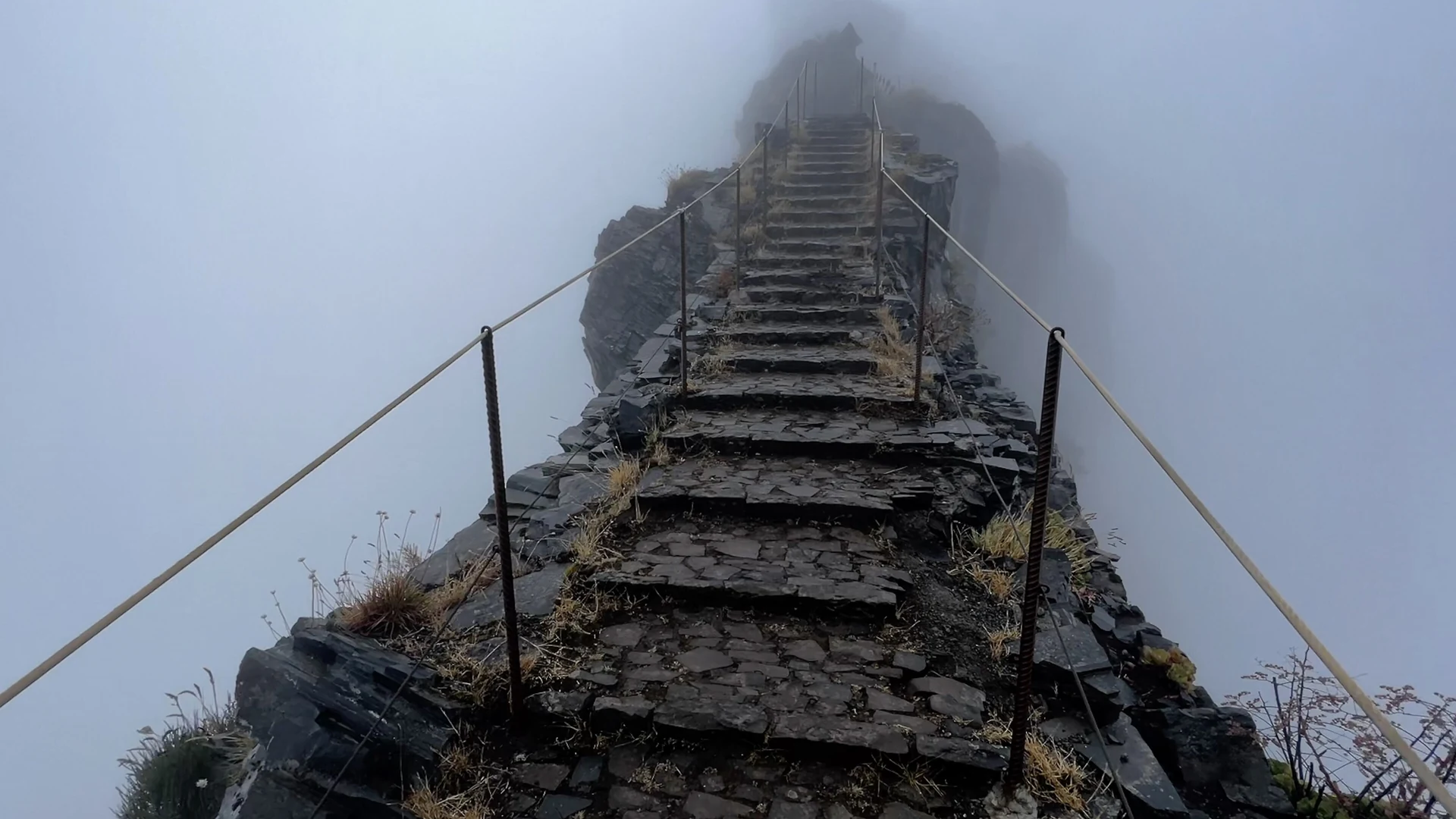
- Terrain: carved stone stairs, narrow ledges, and a series of tunnels, some lit and some not.
- Grade: officially moderate, and it feels considerably harder at altitude before dawn.
Bring a torch and use it: the unlit tunnels are genuinely dark and the floor is uneven. The Ninho da Manta viewpoint, roughly a third of the way along, is the classic photo stop over the Fajã da Nogueira valley.
It is not technical. There are no ropes and no scrambling. What it is, is long, cold and exposed, with enough steps to leave you sore the next day. Anyone wanting a flat, casual viewpoint should stay at the car park and walk the first few hundred metres instead.
The 2026 rules: one-way, booking and fee
This is the single most important thing to plan around, and most older guides get it wrong.
- One-way only: since PR1 reopened on 27 April 2026 after the post-wildfire rebuild, it runs Arieiro to Ruivo only. Walking it in reverse is banned.
- Booking: a timed reservation through the government SIMplifica portal at simplifica.madeira.gov.pt, capacity-limited per slot.
- Fee: €10.50 per person, against €4.50 for every other classified PR trail.
- Enforcement: rangers check on the trail, and there is no ticket booth at the summit.
- Residents: exempt from the fee but still required to reserve.
Book it before you leave your accommodation. Our best hikes in Madeira guide sets PR1 against everything else on the island and explains the booking system across the board.
Transfer or self-drive?
The one-way rule changed this calculation. You can no longer park at Arieiro, walk to Ruivo and stroll back to your car, because the return leg is not permitted.
That leaves self-drivers three options: a short out-and-back from the summit without completing PR1, a taxi from Achada do Teixeira back to your car, or two cars and a shuttle between friends. The car park also fills before dawn on any clear morning and has no overflow, so arriving at first light usually means parking down the road and missing the moment.
A transfer removes both problems at once: hotel pickup, dropped at the summit before dawn, collected at the far end, roughly 8 to 8.5 hours door to door. It is not the only way to do this, but since April it is the tidiest one.
If the forecast is poor
Do not force the dawn start into bad weather. There is no view to salvage, and a dark, freezing, cloud-bound summit is a genuinely miserable two hours.
The better move is the later morning slot, which the same transfer product covers: you still walk PR1 with the light up and the cloud often burning off by mid-morning. Or swap the day for a levada walk lower down, where cloud matters far less.
If you only want the viewpoint without the hike, an east Madeira tour drives up here in daylight as one stop among several.
What to pack
- Head torch: non-negotiable. The first stretch is in darkness and several tunnels are unlit.
- Layers and gloves: it is cold and windy before dawn in any month, and colder still between November and March.
- Grippy shoes: the steps are uneven, worn smooth in places and slippery when damp.
- Water and food: there is nothing to buy between the summit café and Achada do Teixeira.
- A rain layer: weather at 1,800 m turns faster than the forecast suggests.
It is the headline mountain day in our things to do in Madeira guide, and worth pairing with something gentle the following day, because your legs will know about it.
Featured image: Krzysztof Popławski / Wikimedia Commons / CC BY 4.0