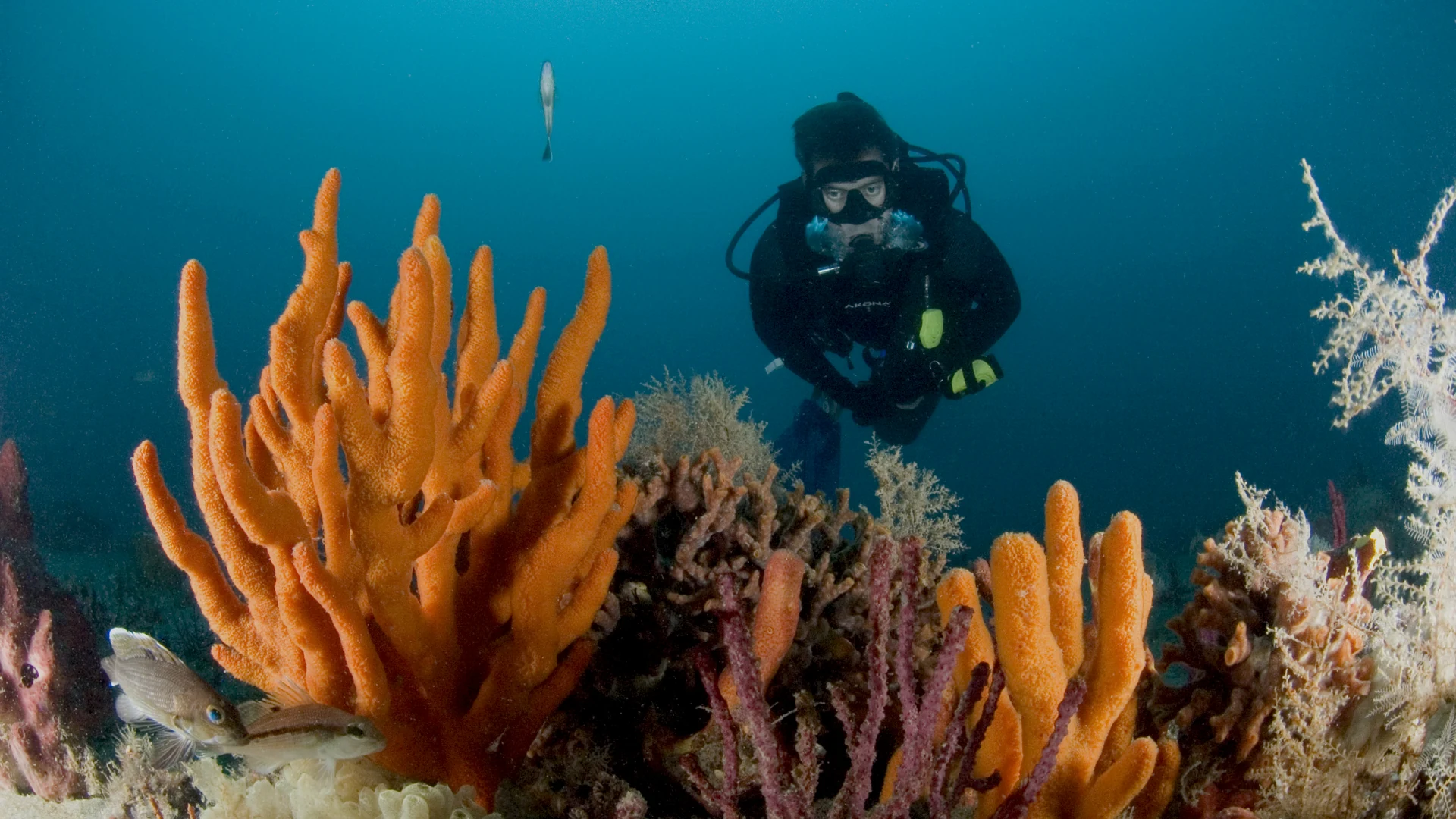
You do not need experience or a certification to dive in Madeira. On a try-dive a PADI instructor runs you through the basics in a training pool, then takes you on a shallow reef dive in Funchal's marine protected area, staying beside you the whole time. It takes 2 to 3 hours, costs from ~€43, and includes hotel pickup.
Two rules worth knowing before you book. The pool session takes children from 8 and the sea dive from 10, and you must not fly for at least 12 hours afterwards, so do not book it for your departure morning.
Funchal: Scuba Diving Experience for Beginners
A first dive with no experience: a PADI instructor runs you through the basics in a training pool, then takes you onto a protected reef near Funchal, staying beside you the whole time. Hotel pickup included.
- No certification needed, PADI instructor one-to-one in the water
- Pool session first, then a shallow reef dive
- Funchal's marine protected area, hotel pickup included
- Pool from age 8, ocean dive from age 10
Total price from
~€43
Includes taxes and fees
Powered by Madeira Divepoint
How a beginner try-dive works
The day starts on land at the dive centre with a briefing: how the regulator works, how to clear a mask, how to equalise your ears, and the hand signals you will actually use. Nothing technical, and no exam at the end. This is a taster, not a course.
Then the pool. You kneel in shallow water, breathe underwater for the first time, and practise the two or three skills that matter until they stop feeling strange. Most people need about twenty minutes to relax; a few need longer, and the instructors are used to that.
Only then do you go into the sea, shallow, close to shore, with the instructor holding position beside you throughout. You are not navigating, managing air or making decisions. You are looking at fish.
Of the two to three hours the whole thing takes, you spend a fairly small proportion actually underwater. That is normal for a try-dive, and worth knowing so it does not disappoint.
Where you dive: Garajau and Funchal's marine reserve
The Reserva Natural Parcial do Garajau was declared in 1986 and was Portugal's first exclusively marine protected area, covering roughly 376 hectares of coast east of Funchal. Local pressure over collapsing fish stocks is what created it.
Restricting fishing worked, and the result is the reason people dive here. Large dusky groupers, fish that can pass a metre, come up to divers instead of fleeing them, because nothing has hunted them in forty years. Add shoals of smaller fish, octopus, the occasional ray and visibility that commonly runs 15 to 40 m.
Be clear about where a beginner actually goes, though. The try-dive runs from the Madeira Divepoint site on its own house reef inside Funchal's protected water, not on the headline reserve dive sites. Those are where certified divers go. You get protected water and real fish; you do not get the deep Garajau walls on your first day.
Snorkelling off the shore at Garajau is a different, cheaper thing again, and worth doing on its own, as our best beaches guide covers.
Can you dive in Madeira in winter?
Yes, and it is one of the reasons the island works for diving. The Atlantic here runs from around 18°C in late winter to 23 or 24°C in late summer, so operators dive all year with a suitable wetsuit.
Winter trades comfort for quiet. You wear more neoprene, the water is a shade less clear after storms, and there are far fewer people in the water. What you lose is reliability: Atlantic swell cancels more dives between November and March, so leave slack in your plans rather than booking your last morning.
If the sea shuts the ocean dive down, most operators can still run a pool-only session, which is a reasonable fallback for a nervous first-timer but not much of a day out on its own. The same swell that stops diving stops coasteering, so those two do not make good backups for each other.
The health and safety rules that matter
These are the parts people skip and then regret, so they are worth stating plainly.
- No flying for at least 12 hours after a single no-decompression dive. Published guidance extends that to 18 hours after several dives or diving on consecutive days. Never book a dive for the day you fly home.
- Declare your health honestly at booking: ear, sinus, heart or respiratory problems, epilepsy, pregnancy, or recent surgery. Some of these rule diving out, others just need a doctor's sign-off.
- Age limits: the pool session takes children from 8 and the ocean dive from 10.
- Congestion: if you cannot equalise your ears, you cannot descend. A cold on the day is a lost dive, not a matter of pushing through.
Is it worth it?
At around €43, a try-dive is one of the lowest-risk ways to find out whether diving is for you. Groups are small enough that you get real instructor attention, the gear is provided, and you surface knowing something about yourself either way.
What tips it in Madeira's favour specifically is the marine reserve. Plenty of resorts will sell you a first dive over unremarkable sand. Here you get a genuinely recovered ecosystem, with fish big enough and bold enough that you notice them without knowing what you are looking at.
Skip it if deep water genuinely frightens you rather than just making you nervous. Snorkelling costs almost nothing and shows you a good deal of the same shallow life. It is otherwise one of the better active half-days in our things to do in Madeira guide, and it pairs well with a whale watching trip for a full water-based day.
What to bring
- Swimwear: worn under your clothes, since changing facilities are basic.
- Towel and a dry change: you will be wet for the better part of three hours.
- Medical information: any relevant condition or medication, plus your doctor's clearance if you need one.
- Nothing else: wetsuit, mask, fins, regulator, tank and weights are all provided.
Featured image: National Marine Sanctuaries / Wikimedia Commons / Public domain